Yakima County Washington Police Scanner Live Today
Yakima County, Washington Police Scanner Live
Police, Fire & EMS Scanner Live Audio
Yakima County Washington Police Scanner Live Today
In Yakima County, Washington, no sheriff name was verified in the sources checked. The office was on the November 3, 2026 ballot, and no outcome was verified — unofficial, pending canvass and certification, and no county-specific radio system was verified in the sources checked. The county seat is Yakima. No sheriff dispatch frequency or talkgroup was verified in the sources checked. Sheriff dispatch encryption is Not verified as of November 2026.
| At a glance | Info |
|---|---|
| County seat | Yakima |
| Population | 256,728 (2020 Census) |
| Area | 4296 sq mi (Census QuickFacts 2020, land area) |
| FIPS code | 53077 |
| Sheriff | Not verified — office on the November 3, 2026 ballot; outcome not verified |
| Time zone | Pacific (America/Los_Angeles) |
| Encryption summary | Not verified |
Listen to Yakima police scanner audio
No county-specific radio system was verified in the sources checked for Yakima County. No single statewide sheriff trunked system was verified for Washington, and no talkgroup or frequency is assigned here without a source.
The county has 256,728 people in the 2020 Census across 4296 square miles, with Yakima as the county seat.
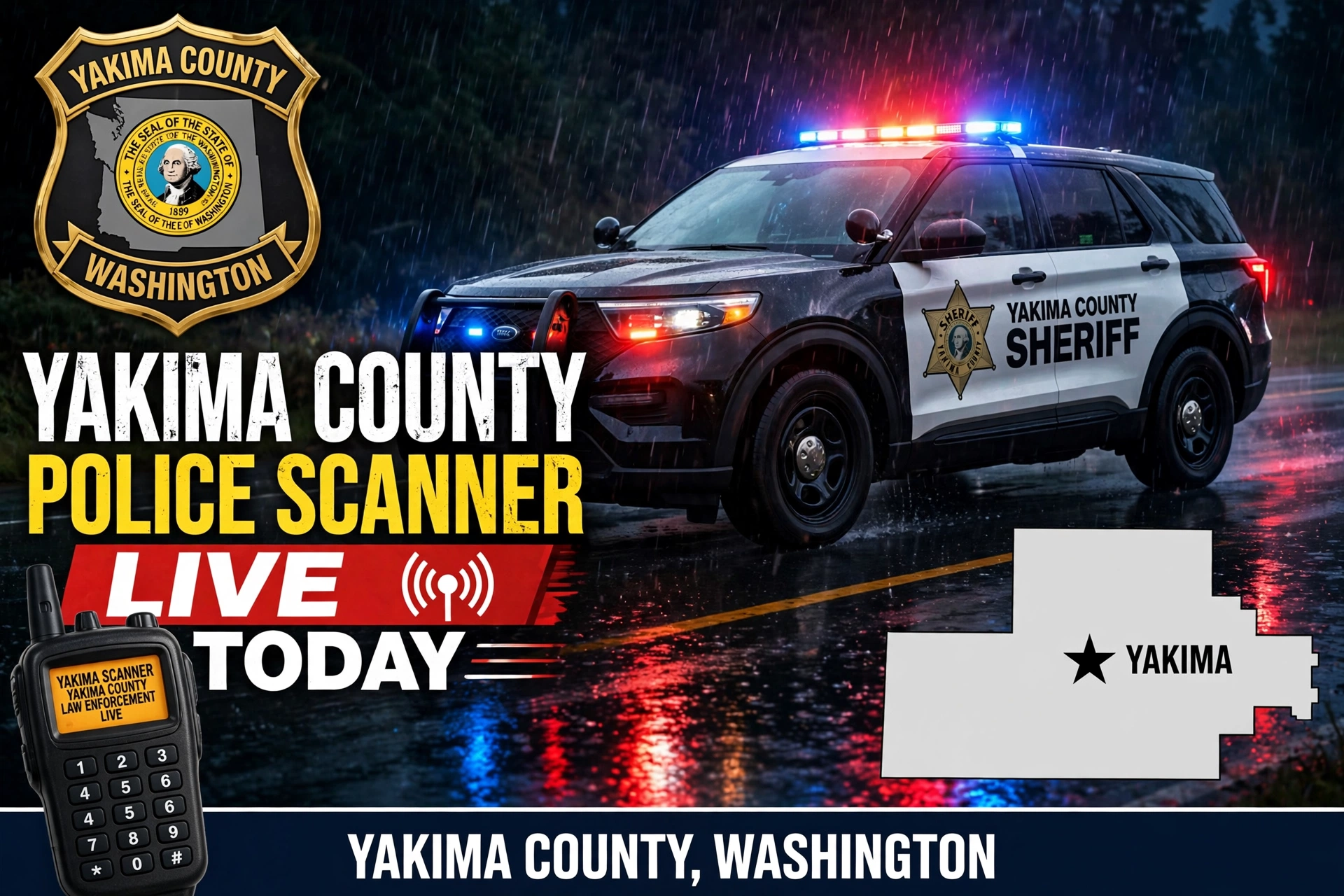
Use the audio player at the top of this page to listen while you read. The player dashboard above shows the county, the state, the feed status, the coverage and the local time in the county time zone. The clock widget below the player shows the current local time, so you can tell at a glance whether the feed is live during local dispatch hours.
What you can hear in Yakima County
These are the main channels in Yakima County, Washington, as far as they could be verified. No sheriff dispatch frequency or talkgroup was verified in the sources checked, so the table records that plainly rather than guessing a channel.
| Agency | Role | Jurisdiction | Radio system | Listening status (Nov 2026) |
|---|---|---|---|---|
| Sheriff dispatch | Law enforcement | Countywide | No county system verified in sources checked | Not verified |
| Fire dispatch | Fire | Countywide | No county system verified in sources checked | Not verified |
| EMS dispatch | EMS | Countywide | No county system verified in sources checked | Not verified |
Is Yakima County police radio encrypted?
Encryption statuses on this page use only the labels Clear, Partly encrypted, Fully encrypted, Varies by channel, or Not verified.
| Agency | Status | As of | What it covers |
|---|---|---|---|
| Sheriff dispatch | Not verified | November 2026 | No talkgroup-level flag seen |
| Fire dispatch | Not verified | November 2026 | No talkgroup-level flag seen |
| EMS dispatch | Not verified | November 2026 | No talkgroup-level flag seen |
A single listing flag is not two sources. Where a second independent source was not found, the verdict is recorded as Not verified, and the gap is carried for a January 2027 re-check.
Radio systems and frequencies
No county-specific radio system was verified in the sources checked for Yakima County. No single statewide sheriff trunked system was verified for Washington, so no statewide talkgroups are assigned to the sheriff’s office here.
Without a verified system, a listener should confirm whether the county uses conventional channels or a trunked system before buying or programming a scanner. A conventional system gives each channel its own frequency, while a trunked system shares a pool of frequencies and identifies each conversation by talkgroup number, and the two need different scanners and different programming.
No sheriff dispatch frequency or talkgroup DEC was individually verified in the sources checked for Yakima County, and no fire or EMS talkgroup DECs were individually verified either. Listeners should confirm the current channels before programming a scanner.
When choosing a scanner for this county, confirm the system type first, because no county-specific system was verified in the sources checked. A digital trunk-tracking scanner handles P25 trunked talkgroups and conventional digital channels, while an analog-only scanner can only follow conventional analog channels. A scanner that only scans frequencies will miss most trunked traffic, because trunked calls move between frequencies. Confirm the current system before buying, and confirm the current channels before programming.
Washington has no single statewide sheriff trunked system that was verified in the sources checked. Each county’s system must be confirmed on its own, because a system that serves one county does not necessarily serve the next. That is why this article does not assign a statewide or neighboring county’s talkgroups to this county, and why listeners should confirm the current channels for this county before programming a scanner.
Start with the sheriff dispatch channel, then add the fire and EMS dispatch channels. Add local police, tactical and secondary channels after the main dispatch channels are working. Keep a note of which channels are encrypted and which are not verified, so a silent channel is not mistaken for a programming error. If a channel stays silent for days, check the current listing before assuming the scanner is at fault.
A channel that stays silent does not always mean the scanner is broken. Some channels carry very little traffic, especially in a small county, and a quiet day can pass with almost no calls. A channel can also be silent because it is encrypted, because the agency has moved to a different channel, or because the scanner is out of range of the site that carries it. Check the programming, the range and the current listing before concluding the channel is gone.
Radio channels change. Agencies move to new systems, add talkgroups, retire old frequencies and switch encryption on or off, and a listing that was right last year can be out of date. Before programming a scanner for a trip or an incident, confirm the current channels against a current listing. The encryption statuses on this page are dated November 2026, and they will be re-checked in January 2027.
Fire and EMS dispatch is where much of the day-to-day traffic sits in a county like this one. Fire calls, medical calls and rescue calls run on the fire and EMS dispatch channels, and they are often busier than law-enforcement channels during the day. No fire or EMS talkgroup DECs were individually verified in the sources checked here, so the table records that plainly. Confirm the current fire and EMS channels before programming, and start with the main dispatch channel.
Listening online and listening on a scanner are two different things. The audio player at the top of this page plays the live feed for this county, and it needs nothing more than a browser. A scanner, by contrast, receives the radio signals directly, so it works without an internet connection and follows the system in real time. The feed is the easy way to listen while reading; the scanner is the way to hear traffic that no feed carries.
Dispatch traffic follows the day. Mornings and evenings are usually the busiest, with shift changes, traffic stops and calls for service, while the small hours are often quiet except for the occasional call. Weekends can be busier than weekdays in a county with a lot of through traffic or recreation. If the feed sounds quiet at 3 a.m., that is normal; try again during the day, when dispatch traffic picks up.
Encryption decides what any scanner can hear. A channel broadcast in the clear can be heard on any scanner that covers the system. A partly encrypted channel carries some traffic in the clear and some encrypted, so a scanner hears the clear part and skips the rest. A fully encrypted channel stays silent on every scanner, because no scanner can decrypt it. That silence is expected, and no setting, antenna or accessory will open an encrypted channel.
The line that matters most is encryption. Listening to a channel broadcast in the clear is lawful, and owning a scanner that receives clear traffic is lawful too. Intercepting or decrypting an encrypted communication is a federal offense under the Electronic Communications Privacy Act, and no scanner setting changes that. Do not transmit on public-safety frequencies, and do not use a scanner to help commit a crime or to evade law enforcement.
Population density shapes what you hear. A county with a few people per square mile has long quiet stretches between calls, because there are fewer people to generate them and larger distances for deputies to cover. A denser county has steadier traffic through the day. Either way, the feed and the scanner both follow the same pattern: busy at shift change and in the evening, quiet in the small hours.
A day on the scanner has a shape of its own. The early morning brings shift changes and the first calls of the day. Midday brings traffic stops, welfare checks and calls for service. The evening brings the second rush, with more traffic and more calls, and the night quiets down to the occasional patrol check and the rare late call. Learning that shape helps a listener know when to tune in and when a quiet channel is simply a quiet hour.
Range matters as much as programming. A scanner with its stock antenna hears the sites nearest to it, and a better antenna or a higher location hears more. Trunked systems are built from sites spread across the county, and a listener at the edge of the county may hear one site clearly and another not at all. If a system shows up but a talkgroup never stops, range is one of the first things to check, along with the control channel and the lockout list.
Counties do not work alone. A fire in one county can bring engines from the next, a pursuit can cross a county line, and a search can pull deputies from three counties at once. Mutual-aid channels and shared talkgroups exist for exactly those moments, and they are often the most interesting traffic a listener hears. The neighboring counties listed at the end of this article are the ones most likely to appear on those shared channels.
The player dashboard at the top of this page shows the feed status, the coverage and the local time, so a listener can tell at a glance whether the feed is live. A feed can go quiet for ordinary reasons: the provider’s internet drops, the feed computer restarts, or the county goes quiet for an hour. If the dashboard shows the feed as online but nothing is playing, the county may simply be between calls, and the clock widget below the player shows the local time to judge that by.
Weather changes what the scanner carries. A storm brings more crashes, more disabled vehicles and more fire and EMS calls, and a snow day can fill the dispatch channels from morning to night. A heat wave brings more medical calls. Listeners who follow the weather as well as the scanner will hear the pattern: quiet days stay quiet, and bad-weather days get busy fast, with mutual aid and neighboring counties joining in.
Scanner listening has been a hobby for decades, and the equipment has changed with the radio systems. Early scanners tuned one frequency at a time and stopped whenever there was a signal. Trunk-tracking scanners followed, able to follow a conversation across a pool of frequencies. Digital scanners added P25 decoding, and now software and online feeds let anyone listen without a radio at all. The hobby changed, but the idea stayed the same: hearing what the public-safety agencies in your county are doing, as they do it.
A scanner is also a practical tool in an emergency. When a fire, a flood or a storm hits a county, the dispatch channels carry the first reports, the road closures and the evacuation notices, often before anything else. A listener who knows the local channels can follow what is happening street by street, rather than waiting for the news. Keep the feed or the scanner charged and the channels programmed before the emergency, not during it.
Recent radio changes
No dated county-specific migration note was found in the sources checked beyond the statewide-system note above.
Agencies
Yakima County Sheriff’s Office
No sheriff name was verified in the sources checked. The office was on the November 3, 2026 ballot, and no outcome was verified — unofficial, pending canvass and certification. Washington county sheriffs serve 4-year terms; election years are staggered by county. This office was on the November 3, 2026 ballot; no outcome was verified — unofficial, pending canvass and certification. No verified sheriff’s office address or non-emergency phone was found in the sources checked.
Coverage across the county
Yakima County covers 4296 square miles, with 256,728 people in the 2020 Census. Yakima is the county seat. That works out to about 60 people per square mile. Bordering areas are Kittitas County, Grant County, Benton County, Klickitat County, Skamania County, Lewis County, and Pierce County.
Is it legal to listen to a police scanner in Washington?
Yes, listening to a police scanner is legal in Washington. A scanner that receives traffic broadcast in the clear is lawful to own and listen to at home. The boundary is encryption: under the federal Electronic Communications Privacy Act, 18 USC 2511, intercepting or decrypting an encrypted communication is a federal offense, while receiving a readily accessible radio transmission is lawful. Do not try to decrypt encrypted channels, do not transmit on public-safety frequencies, and do not use a scanner to help commit a crime or to evade law enforcement. This page is general information, not legal advice.
How to listen
To hear Yakima County, first confirm the county’s radio system: no county-specific system was verified in the sources checked, so confirm whether the county uses conventional channels or a trunked system before programming. No Yakima County talkgroup numbers were individually verified.
A scanner that covers the system in use is needed: a digital trunk-tracking scanner for a P25 trunked system, or a conventional scanner for conventional channels. Start with the sheriff dispatch channel and the fire and EMS dispatch channels, then add tactical and secondary channels. If a channel is encrypted, the scanner will skip it or play silence; that is expected, and no setting will open an encrypted channel.
Troubleshooting
If you hear nothing, check that the scanner covers the system listed above and that the channels are programmed, before concluding the channel is silent.
Encryption is Not verified for the channels in this county, so a channel that stays silent may be encrypted or may simply carry little traffic.
If a channel stays silent, check that the system type is confirmed and that the frequency and mode, or the talkgroup and system, are programmed correctly, and that the scanner is in range. A channel with no traffic is silent even when everything is programmed correctly. Encrypted channels stay silent on any scanner.
Nearby counties
Yakima county is bordered by Kittitas County, Grant County, Benton County, Klickitat County, Skamania County, Lewis County, and Pierce County.
Another Washington county covered on this site is Whitman County Washington Police Scanner Live Today, with live audio, frequencies and the county’s encryption status.
Frequently asked questions
Is the Yakima county sheriff’s radio encrypted? Not verified as of November 2026. No encryption flag was verified for the sheriff dispatch channel, so it is not presented as clear.
Who is the Yakima county sheriff? No sheriff name was verified in the sources checked. The office was on the November 3, 2026 ballot, and no outcome was verified — unofficial, pending canvass and certification.
What is the sheriff dispatch frequency in Yakima county? No sheriff dispatch frequency was verified in the sources checked.
What radio system does Yakima county use? No county-specific radio system was verified in the sources checked. No single statewide sheriff trunked system was verified for Washington.
What is the county seat of Yakima County? Yakima.
What is the FIPS code for Yakima county? 53077. The 2020 Census population is 256,728.
What is the address and phone number for the Yakima County Sheriff’s Office? No verified address or non-emergency phone was found in the sources checked.
What time zone is Yakima county in? Pacific (America/Los_Angeles). The whole county is in the Pacific time zone.
When is the next Yakima county sheriff election? The office was on the November 3, 2026 ballot; no outcome was verified — unofficial, pending canvass and certification.
What counties border Yakima county? Kittitas County, Grant County, Benton County, Klickitat County, Skamania County, Lewis County, Pierce County.
Can I listen to the Yakima county police scanner online? Yes. Use the audio player at the top of this page to listen while you read. The player dashboard shows the county, the feed status and the local time.
Do I need a special scanner for Yakima county? It depends on the system, and no county-specific system was verified in the sources checked. Confirm whether the county uses conventional channels or a trunked system first, then choose a scanner that covers it.
Official public safety resources
No verified address or non-emergency phone was found for the Yakima County Sheriff’s Office in the sources checked.
If you have an emergency, call 911.
One Comment