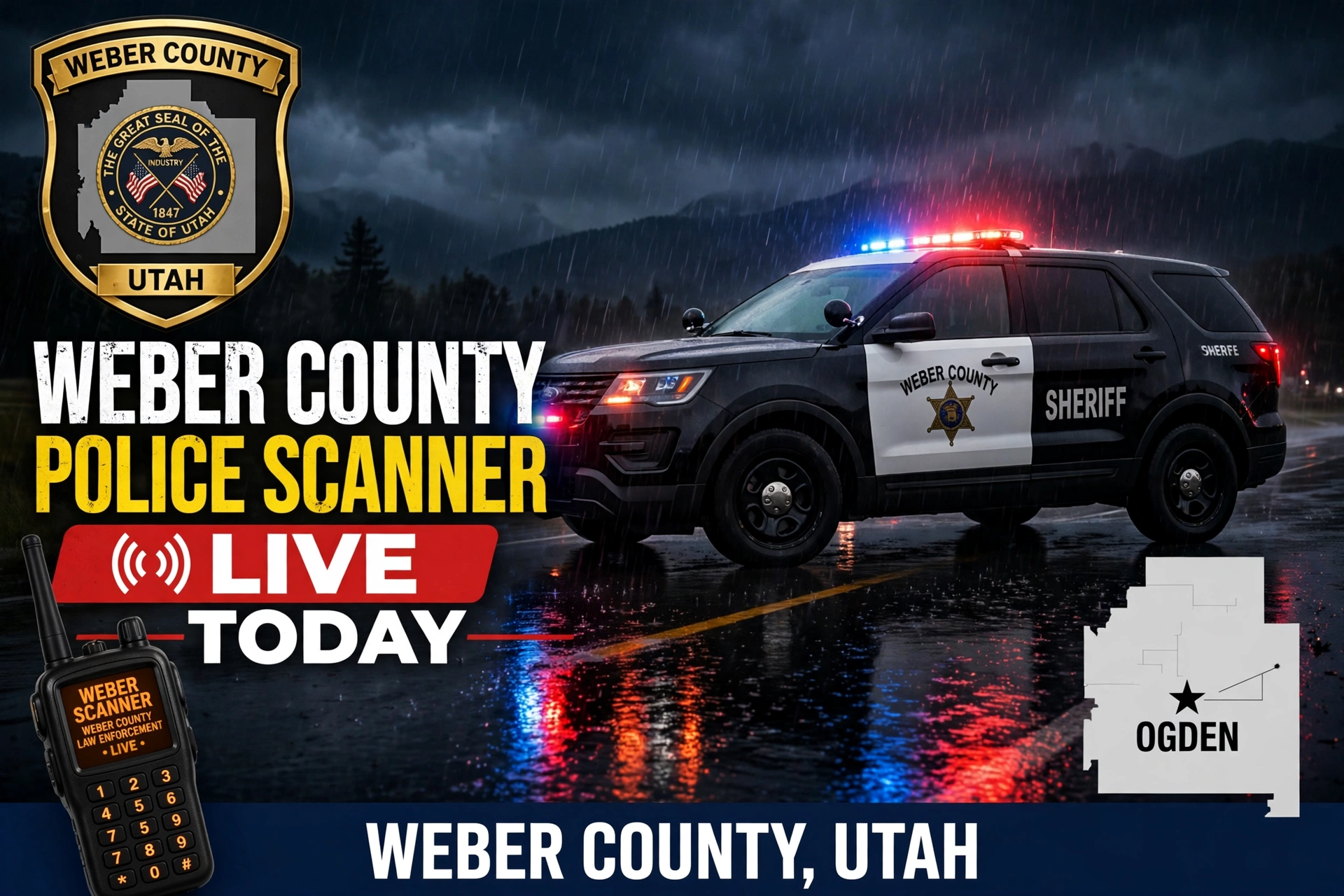
Weber County Utah Police Scanner Live Today
Weber County, Utah Police Scanner Live
Police, Fire & EMS Scanner Live Audio
Weber County Utah Police Scanner Live Today
In Weber County, Utah, Sheriff Ryan Arbon leads the sheriff’s office, and law enforcement, fire and EMS traffic runs on UCA P25 Phase II. The county seat is Ogden. No sheriff dispatch frequency or talkgroup was verified in the sources checked. Sheriff dispatch encryption is Not verified as of November 2026.
| At a glance | Info |
|---|---|
| County seat | Ogden |
| Population | 262,223 (2020 Census) |
| Area | 659 sq mi (Census QuickFacts 2020, land area) |
| FIPS code | 49057 |
| Sheriff | Ryan Arbon |
| Time zone | Mountain (America/Denver) |
| Encryption summary | Not verified |
Listen to Weber police scanner audio
Utah Communications Authority (UCA) statewide P25 Phase II trunked system, sid 12042 (SysIDs 00A / 014 / 01E / 028, WACN 92527), which replaced the older UCA Motorola system. County agencies use UCA talkgroups; no UCA talkgroup is assigned to a county agency here without a source. No Weber County UCA site name, control frequency or talkgroup DEC was individually verified in the sources checked.
The county has 262,223 people in the 2020 Census across 659 square miles, with Ogden as the county seat.
Use the audio player at the top of this page to listen while you read. The player dashboard above shows the county, the state, the feed status, the coverage and the local time in the county time zone. The clock widget below the player shows the current local time, so you can tell at a glance whether the feed is live during local dispatch hours.
What you can hear in Weber County
These are the main channels in Weber County, Utah, as far as they could be verified. No sheriff dispatch frequency or talkgroup was verified in the sources checked, so the table records that plainly rather than guessing a channel.
| Agency | Role | Jurisdiction | Radio system | Listening status (Nov 2026) |
|---|---|---|---|---|
| Sheriff dispatch | Law enforcement | Countywide | UCA P25 Phase II | Not verified |
| Fire dispatch | Fire | Countywide | UCA P25 Phase II | Not verified |
| EMS dispatch | EMS | Countywide | UCA P25 Phase II | Not verified |
Is Weber County police radio encrypted?
Encryption statuses on this page use only the labels Clear, Partly encrypted, Fully encrypted, Varies by channel, or Not verified.
| Agency | Status | As of | What it covers |
|---|---|---|---|
| Sheriff dispatch | Not verified | November 2026 | No talkgroup-level flag seen |
| Fire dispatch | Not verified | November 2026 | No talkgroup-level flag seen |
| EMS dispatch | Not verified | November 2026 | No talkgroup-level flag seen |
A single listing flag is not two sources. Where a second independent source was not found, the verdict is recorded as Not verified, and the gap is carried for a January 2027 re-check.
Radio systems and frequencies
The Utah Communications Authority (UCA) statewide P25 Phase II trunked system, sid 12042 (SysIDs 00A / 014 / 01E / 028, WACN 92527), replaced the older UCA Motorola system. County agencies use UCA talkgroups; no UCA talkgroup is assigned to a county agency here without a source.
The UCA system is a statewide P25 Phase II trunked system. Instead of one frequency per channel, radios share a pool of frequencies and the system assigns one for each call, identified by talkgroup number. A scanner must track the system and follow its control channel to hear a talkgroup; programming a single frequency from the system will not follow conversations. The older UCA Motorola system has been replaced, and its talkgroup categories are deprecated.
The listing gives no conventional frequencies and no individually verified talkgroup numbers for Weber County. All traffic is on the UCA P25 Phase II system, and no talkgroup number is assigned to a county agency here without a source.
A trunked system works differently from a set of ordinary channels. Instead of giving each talkgroup its own frequency, the system holds a pool of frequencies and assigns one to each call as it happens. The talkgroup number is what identifies the conversation, and the scanner follows the system control channel to find it. That is why a trunked talkgroup cannot be heard by programming a single frequency and scanning: the frequency changes from call to call, while the talkgroup number stays the same.
When choosing a scanner for this county, look first at the system type above. A digital trunk-tracking scanner handles P25 trunked talkgroups and conventional digital channels, while an analog-only scanner can only follow conventional analog channels. A scanner that only scans frequencies will miss most trunked traffic, because trunked calls move between frequencies. Check the system type before buying, and confirm the current channels before programming.
Start with the sheriff dispatch channel, then add the fire and EMS dispatch channels. Add local police, tactical and secondary channels after the main dispatch channels are working. Keep a note of which channels are encrypted and which are not verified, so a silent channel is not mistaken for a programming error. If a channel stays silent for days, check the current listing before assuming the scanner is at fault.
A channel that stays silent does not always mean the scanner is broken. Some channels carry very little traffic, especially in a small county, and a quiet day can pass with almost no calls. A channel can also be silent because it is encrypted, because the agency has moved to a different channel, or because the scanner is out of range of the site that carries it. Check the programming, the range and the current listing before concluding the channel is gone.
Radio channels change. Agencies move to new systems, add talkgroups, retire old frequencies and switch encryption on or off, and a listing that was right last year can be out of date. Before programming a scanner for a trip or an incident, confirm the current channels against a current listing. The encryption statuses on this page are dated November 2026, and the January 2027 re-check noted in the owner notes is the next planned review.
Fire and EMS dispatch is where much of the day-to-day traffic sits in a county like this one. Fire calls, medical calls and rescue calls run on the fire and EMS dispatch channels, and they are often busier than law-enforcement channels during the day. No fire or EMS talkgroup DECs were individually verified in the sources checked here, so the table records that plainly. Confirm the current fire and EMS channels before programming, and start with the main dispatch channel.
Listening online and listening on a scanner are two different things. The audio player at the top of this page plays the live feed for this county, and it needs nothing more than a browser. A scanner, by contrast, receives the radio signals directly, so it works without an internet connection and follows the system in real time. The feed is the easy way to listen while reading; the scanner is the way to hear traffic that no feed carries.
Dispatch traffic follows the day. Mornings and evenings are usually the busiest, with shift changes, traffic stops and calls for service, while the small hours are often quiet except for the occasional call. Weekends can be busier than weekdays in a county with a lot of through traffic or recreation. If the feed sounds quiet at 3 a.m., that is normal; try again during the day, when dispatch traffic picks up.
Encryption decides what any scanner can hear. A channel broadcast in the clear can be heard on any scanner that covers the system. A partly encrypted channel carries some traffic in the clear and some encrypted, so a scanner hears the clear part and skips the rest. A fully encrypted channel stays silent on every scanner, because no scanner can decrypt it. That silence is expected, and no setting, antenna or accessory will open an encrypted channel.
The UCA system replaced the older UCA Motorola system statewide, and the old system’s talkgroup categories are deprecated. That matters when reading older listings or older scanner files: talkgroup numbers from the Motorola system do not carry over to the P25 system, and a file built for the old system will not follow the new one. Use the current P25 system, and treat any Motorola-era talkgroup list as historical rather than current.
The line that matters most is encryption. Listening to a channel broadcast in the clear is lawful, and owning a scanner that receives clear traffic is lawful too. Intercepting or decrypting an encrypted communication is a federal offense under the Electronic Communications Privacy Act, and no scanner setting changes that. Do not transmit on public-safety frequencies, and do not use a scanner to help commit a crime or to evade law enforcement.
Population density shapes what you hear. A county with a few people per square mile has long quiet stretches between calls, because there are fewer people to generate them and larger distances for deputies to cover. A denser county has steadier traffic through the day. Either way, the feed and the scanner both follow the same pattern: busy at shift change and in the evening, quiet in the small hours.
A day on the scanner has a shape of its own. The early morning brings shift changes and the first calls of the day. Midday brings traffic stops, welfare checks and calls for service. The evening brings the second rush, with more traffic and more calls, and the night quiets down to the occasional patrol check and the rare late call. Learning that shape helps a listener know when to tune in and when a quiet channel is simply a quiet hour.
Range matters as much as programming. A scanner with its stock antenna hears the sites nearest to it, and a better antenna or a higher location hears more. Trunked systems are built from sites spread across the county, and a listener at the edge of the county may hear one site clearly and another not at all. If a system shows up but a talkgroup never stops, range is one of the first things to check, along with the control channel and the lockout list.
Counties do not work alone. A fire in one county can bring engines from the next, a pursuit can cross a county line, and a search can pull deputies from three counties at once. Mutual-aid channels and shared talkgroups exist for exactly those moments, and they are often the most interesting traffic a listener hears. The neighboring counties listed at the end of this article are the ones most likely to appear on those shared channels.
The player dashboard at the top of this page shows the feed status, the coverage and the local time, so a listener can tell at a glance whether the feed is live. A feed can go quiet for ordinary reasons: the provider’s internet drops, the feed computer restarts, or the county goes quiet for an hour. If the dashboard shows the feed as online but nothing is playing, the county may simply be between calls, and the clock widget below the player shows the local time to judge that by.
Weather changes what the scanner carries. A storm brings more crashes, more disabled vehicles and more fire and EMS calls, and a snow day can fill the dispatch channels from morning to night. A heat wave brings more medical calls. Listeners who follow the weather as well as the scanner will hear the pattern: quiet days stay quiet, and bad-weather days get busy fast, with mutual aid and neighboring counties joining in.
Scanner listening has been a hobby for decades, and the equipment has changed with the radio systems. Early scanners tuned one frequency at a time and stopped whenever there was a signal. Trunk-tracking scanners followed, able to follow a conversation across a pool of frequencies. Digital scanners added P25 decoding, and now software and online feeds let anyone listen without a radio at all. The hobby changed, but the idea stayed the same: hearing what the public-safety agencies in your county are doing, as they do it.
A scanner is also a practical tool in an emergency. When a fire, a flood or a storm hits a county, the dispatch channels carry the first reports, the road closures and the evacuation notices, often before anything else. A listener who knows the local channels can follow what is happening street by street, rather than waiting for the news. Keep the feed or the scanner charged and the channels programmed before the emergency, not during it.
Recent radio changes
No dated county-specific migration note was found in the sources checked beyond the statewide-system note above.
The statewide note is the UCA P25 Phase II replacement of the older UCA Motorola system.
Agencies
Weber County Sheriff’s Office
Ryan Arbon is the sheriff of Weber County. Sheriff Arbon was elected in November 2018 and continues to lead the office. Utah county sheriffs serve 4-year terms under Utah Code Title 17, Chapter 16. The current term runs 2023 to early January 2027. The office was on the November 3, 2026 general-election ballot, with the next term January 2027 to January 2031 and the next election November 2030. No outcome from the November 3, 2026 ballot was verified in the sources checked. No verified sheriff’s office address or non-emergency phone was found in the sources checked.
Coverage across the county
Weber County covers 659 square miles, with 262,223 people in the 2020 Census. Ogden is the county seat. That works out to about 398 people per square mile. Bordering areas are Box Elder County, Cache County, Rich County, Morgan County, Davis County, and Tooele County.
Is it legal to listen to a police scanner in Utah?
Yes, listening to a police scanner is legal in Utah. A scanner that receives traffic broadcast in the clear is lawful to own and listen to at home. The boundary is encryption: under the federal Electronic Communications Privacy Act, 18 USC 2511, intercepting or decrypting an encrypted communication is a federal offense, while receiving a readily accessible radio transmission is lawful. Do not try to decrypt encrypted channels, do not transmit on public-safety frequencies, and do not use a scanner to help commit a crime or to evade law enforcement. This page is general information, not legal advice.
How to listen
To hear Weber County, use a P25 Phase II capable scanner set for the UCA statewide system. No Weber County talkgroup numbers were individually verified in the sources checked, so confirm the current talkgroups before programming.
A P25 Phase II capable scanner is needed for trunked talkgroups. Program the system with the talkgroups listed above, and set the scanner to track the system rather than scanning individual frequencies. Start with the sheriff dispatch talkgroup and the fire and EMS dispatch talkgroups, then add tactical and secondary talkgroups. If a talkgroup is encrypted, the scanner will skip it or play silence; that is expected, and no setting will open an encrypted talkgroup.
Troubleshooting
If you hear nothing, check that the scanner covers the system listed above and that the channels are programmed, before concluding the channel is silent.
Encryption is Not verified for the channels in this county, so a channel that stays silent may be encrypted or may simply carry little traffic.
If a trunked talkgroup stays silent, check that the scanner is tracking the system and that the talkgroup is not locked out. A talkgroup with no traffic is silent even when everything is programmed correctly. If the scanner shows the system but never stops on a talkgroup, check that the system’s control channel is programmed and that the scanner is in range of a site. Encrypted talkgroups stay silent on any scanner.
Nearby counties
Weber county is bordered by Box Elder County, Utah, Cache County, Utah, Rich County, Utah, Morgan County, Utah, Davis County, Utah, and Tooele County, Utah.
Another Utah county covered on this site is Wayne County Utah Police Scanner Live Today, with live audio, frequencies and the county’s encryption status.
Frequently asked questions
Is the Weber county sheriff’s radio encrypted? Not verified as of November 2026. No encryption flag was verified for the sheriff dispatch channel, so it is not presented as clear.
Who is the Weber county sheriff? Ryan Arbon.
What is the sheriff dispatch frequency in Weber county? No sheriff dispatch frequency was verified in the sources checked.
What radio system does Weber county use? UCA P25 Phase II. It replaced the older UCA Motorola system.
What is the county seat of Weber County? Ogden. The sheriff’s office is in Ogden.
What is the FIPS code for Weber county? 49057. The 2020 Census population is 262,223.
What is the address and phone number for the Weber County Sheriff’s Office? No verified address or non-emergency phone was found in the sources checked.
What time zone is Weber county in? Mountain (America/Denver). The whole county is in the Mountain time zone.
When is the next Weber county sheriff election? The office was on the November 3, 2026 ballot; the next term runs January 2027 to January 2031, with the next election November 2030.
What counties border Weber county? Box Elder County, Cache County, Rich County, Morgan County, Davis County, Tooele County.
Can I listen to the Weber county police scanner online? Yes. Use the audio player at the top of this page to listen while you read. The player dashboard shows the county, the feed status and the local time.
Do I need a special scanner for Weber county? It depends on the system. UCA P25 Phase II traffic needs a scanner that supports that system; conventional analog channels need only an analog scanner. See the how-to-listen section above for the system in this county.
Official public safety resources
No verified address or non-emergency phone was found for the Weber County Sheriff’s Office in the sources checked.
If you have an emergency, call 911.
One Comment