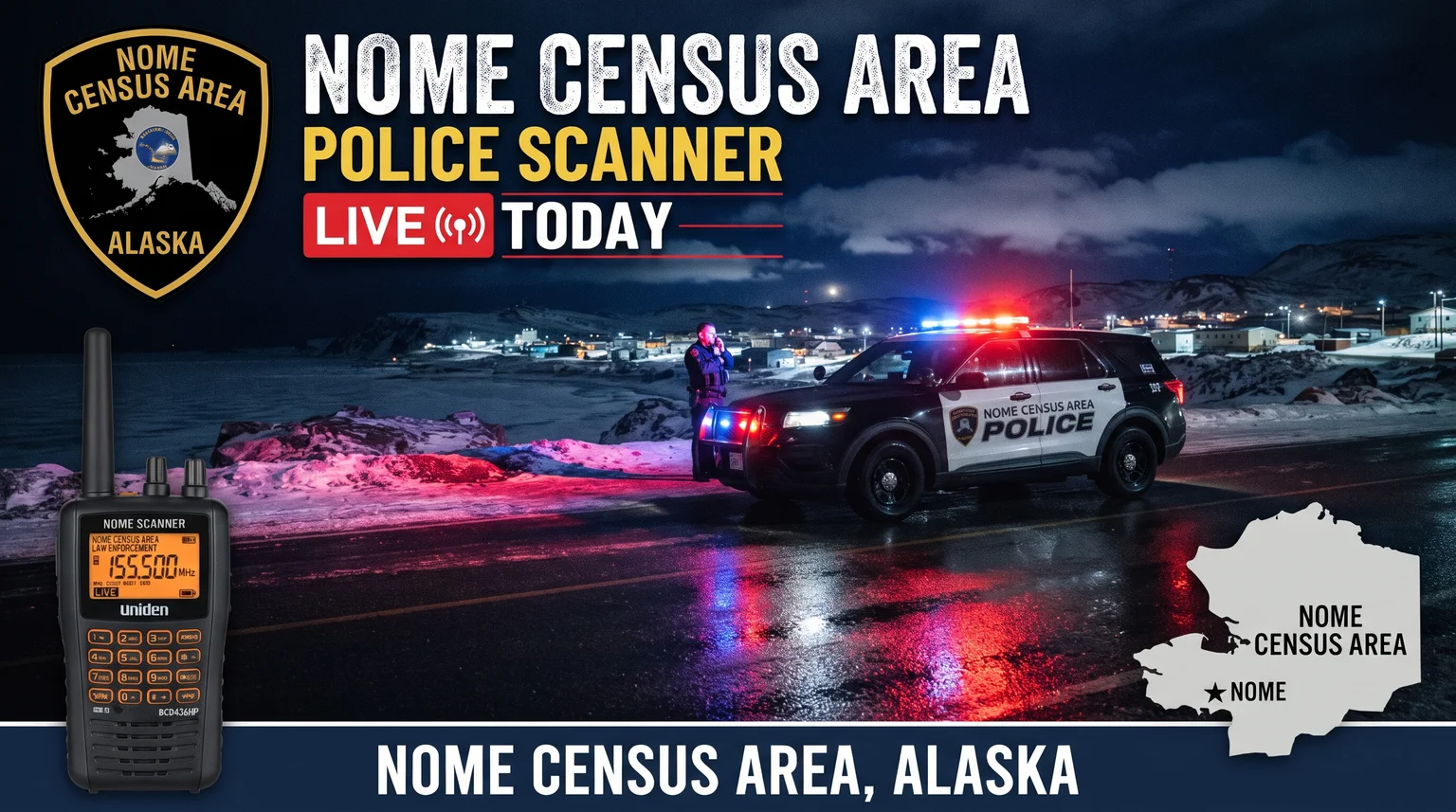
Nome Census Area Alaska Police Scanner Live Today
Nome Census Area, Alaska Police Scanner Live
Police, Fire & EMS Scanner Live Audio
Nome is the end of the Iditarod Trail and the hub of the Seward Peninsula, a roadless region where the Nome Police Department and the Alaska State Troopers Nome Post carry law enforcement, and where there is no ALMR trunked site at all. Police and fire traffic here is conventional VHF, and the troopers’ ALMR talkgroups are encrypted statewide. This page lists what you can hear, the verified conventional frequencies, dated encryption status, and the Alaska rules.
Nome Census Area at a glance
| At a glance | Info |
|---|---|
| Main community | Nome |
| Population | 9,830 (July 1, 2025 estimate); 10,046 (2020 Census) |
| FIPS code | 02180 |
| Main dispatch | Nome Police Department, (907) 443-5262; Alaska State Troopers Nome Post |
| Main radio systems | Conventional VHF; Alaska Land Mobile Radio (ALMR) only by Wi-Fi SmartConnect |
| Encryption summary | State Troopers fully encrypted on ALMR; local VHF varies by channel |
| National Weather Service office | Fairbanks |
Listen to Nome Census Area police scanner audio
Scanner coverage here centers on the Nome Police Department, the Alaska State Troopers Nome Post, the Nome Volunteer Fire Department and the Nome Volunteer Ambulance Department. Outside Nome, law enforcement in the villages rests with Village Public Safety Officers and the troopers, who may be hours away by air. Fire and EMS produce the most listenable traffic, since it is dispatched in the clear on conventional VHF.
What you can hear in Nome Census Area
| Agency | Role | Jurisdiction | Radio system | Listening status (Nov 2026) |
|---|---|---|---|---|
| Nome Police Department | City police | Nome | Conventional VHF | Varies by channel |
| Alaska State Troopers, Nome Post | State law enforcement | Nome Census Area | ALMR P25 Phase II; VHF backup | Fully encrypted on ALMR |
| Nome Volunteer Fire Department | Fire and rescue | Nome | Conventional VHF | Clear |
| Nome Volunteer Ambulance Department | Ambulance service | Nome | Conventional VHF | Clear |
| Village Public Safety Officers | Village first response | Villages across the census area | Conventional VHF | Varies by channel |
Is Nome Census Area police radio encrypted?
| Agency | Status | As of | What it covers |
|---|---|---|---|
| Alaska State Troopers, C Detachment | Fully encrypted | November 2026 | Dispatch, NCIC, traffic, tactical, Village Public Safety talkgroups |
| Nome Police Department | Varies by channel | November 2026 | Channel-by-channel status not published |
| Nome Volunteer Fire Department | Clear | November 2026 | Dispatch and operations |
| Nome Volunteer Ambulance Department | Clear | November 2026 | Dispatch and operations |
| Statewide mutual aid channels | Clear | November 2026 | All-agency emergency, fire mutual aid, search and rescue |
Fully encrypted means the agency’s talkgroups cannot be heard on any scanner. The troopers’ C Detachment talkgroups are all flagged encrypted in the system database, and monitoring reports put encrypted traffic at about 95 percent of trooper operations statewide. Local police and fire in Nome still work on conventional VHF, which is analog and listenable unless a channel is specifically encrypted.
Radio systems and frequencies
Nome Census Area has no ALMR site. The statewide system is the Alaska Land Mobile Radio (ALMR), a P25 Phase II trunked system, but the system database notes that in the C Detachment region ALMR radio coverage is only present on Kodiak Island, and the rest of the area uses simplex, local agency channels or radios enabled with Wi-Fi SmartConnect to ALMR. In practice that means a scanner in Nome listens to conventional VHF. A trunked system is different from a conventional channel: on ALMR, radios share a pool of frequencies and the system assigns a channel for each transmission, while a conventional channel is one frequency, one channel, and anyone with a basic scanner can hear it.
ALMR talkgroups, C Detachment (encrypted)
| Talkgroup | Agency and use | Mode | Source type |
|---|---|---|---|
| 18302 | C Judicial Services | P25 Phase II, encrypted | State system database |
| 18304 | C Kodiak Dispatch | P25 Phase II, encrypted | State system database |
| 18305 | C NCIC | P25 Phase II, encrypted | State system database |
| 18306 | C Traffic | P25 Phase II, encrypted | State system database |
| 18307 | C Tac | P25 Phase II, encrypted | State system database |
| 18309 | C Village Public Safety | P25 Phase II, encrypted | State system database |
Conventional channels, Nome Census Area
| Frequency (MHz) | Agency and use | Mode |
|---|---|---|
| 155.250 | Alaska State Troopers, Nome (KWH511); also statewide law enforcement tactical | FM |
| 155.250 | Statewide all-agency emergency operations | FM |
| 154.445 | Statewide fire mutual aid | FM |
| 155.160 | Statewide search and rescue | FM |
| 154.295 | Fireground, statewide mutual aid | FM |
| 155.340 | Hospital emergency (HEAR) | FM |
| 156.800 | Marine VHF channel 16, distress and calling, Norton Sound | FM |
Agencies
Nome Police Department
The Nome Police Department is headquartered at 500 Bering Street in Nome, (907) 443-5262, and also lists 102 Greg Kruschek Avenue as its address. It patrols the city, answers 911 calls in Nome, and runs a search and rescue unit. Its dispatch number is the number to call for non-emergency police help in the city, and its officers work alongside the troopers and the volunteer fire and ambulance departments.
Alaska State Troopers, Nome Post — C Detachment
The Alaska State Troopers Nome Post, (907) 443-2835, covers the Nome Census Area from Front Street in Nome. It is part of C Detachment, which covers the entire western Alaska region with posts in Nome, Kotzebue, Bethel, Dillingham, Emmonak, Hooper Bay, King Salmon, Kodiak, Saint Mary’s, Selawik, Togiak and Unalakleet. Troopers handle serious crime, search and rescue and village calls across the census area, and their ALMR talkgroups are fully encrypted.
Village Public Safety Officers
Outside Nome, the first response in the villages comes from Village Public Safety Officers, known as VPSOs. The program is funded through the Department of Public Safety and run through regional Native nonprofit organizations. VPSOs serve small, often roadless villages as first responders, and many also handle search and rescue, fire response and emergency medical care, working with troopers who may be hours away by air.
Fire and EMS
The Nome Volunteer Fire Department, (907) 443-2310, and the Nome Volunteer Ambulance Department, based at 505 Bering Street, cover the city from two stations, including the Icy View substation. Norton Sound Regional Hospital in Nome is the regional hospital for the Bering Strait region. Fire and ambulance traffic is dispatched in the clear on conventional VHF.
Coverage across the area
Nome Census Area covers about 23,000 square miles of the Seward Peninsula and the Bering Strait coast, with about 0.4 people per square mile. Nome, population about 3,800, is the only city of any size. The other communities are Brevig Mission, Diomede, Elim, Gambell, Golovin, Koyuk, Savoonga, Shaktoolik, Shishmaref, St. Michael, Stebbins, Teller, Unalakleet, Wales and White Mountain. None of the villages is connected to Nome by road; travel is by air, boat, snowmachine or, in winter, the sea ice. Scanner coverage follows the same pattern: Nome’s channels are heard in town, while village traffic depends on local repeaters and simplex channels that reach only a few miles.
Is it legal to listen to a police scanner in Alaska?
Yes, for traffic broadcast in the clear. Alaska Statute 42.20.320 exempts listening to radio communications that are publicly made, and to emergency communications made in the normal course of operations by a federal, state or local law enforcement agency. Intentionally intercepting a private communication, or divulging one, is a class A misdemeanor (AS 42.20.300, 42.20.310, 42.20.330). Federal law draws the same line: under 18 USC § 2511, intercepting or decrypting an encrypted communication is a federal offence, while receiving a readily accessible radio transmission is lawful. For Nome Census Area, listen to the clear channels listed on this page, and do not try to decrypt the encrypted ones.
How to listen
To hear Nome Census Area on your own radio, start with a basic analog VHF scanner. There is no ALMR site to track here, so a P25 trunk-tracking scanner buys nothing extra unless you travel to a covered area. Program 155.250 MHz for the troopers’ conventional channel and the statewide mutual aid channels 154.445, 155.160, 154.295 and 155.340 MHz, then search the VHF public-safety band around Nome for the police, fire and ambulance channels. A scanner app or a browser player is the simplest option if you do not own a radio, but it will only carry the channels that are broadcast in the clear.
Troubleshooting
If you hear nothing on a trooper channel, the cause in Nome Census Area is usually encryption, not a fault with your radio. Check a fire or ambulance channel first: if fire traffic comes through, your setup is working and the trooper channel is simply encrypted. If you hear nothing at all, remember that village traffic is simplex and short-range, and that Nome’s channels are local to the city. Weather and terrain matter here: VHF does not bend over the peninsula’s hills, and winter storms can knock out repeaters.
Nearby boroughs and census areas
Northwest Arctic Borough, Yukon-Koyukuk Census Area, Kusilvak Census Area, Bethel Census Area.
Another Alaska borough covered on this site is Matanuska-Susitna Borough Alaska Police Scanner Live Today, with live audio, frequencies, talkgroups and the borough’s encryption status.
Frequently asked questions
Can you listen to Nome police on a scanner? Some of it. The Nome Police Department works on conventional VHF, and fire and ambulance traffic is clear. The Alaska State Troopers are fully encrypted on ALMR.
Is the Alaska State Troopers Nome Post encrypted? Yes, on ALMR. All C Detachment talkgroups are flagged encrypted in the system database, as of November 2026.
What scanner do I need for Nome, Alaska? A basic analog VHF scanner. There is no ALMR site in Nome Census Area, so a trunk-tracking scanner is not needed to hear local traffic.
What frequency are the Alaska State Troopers on in Nome? 155.250 MHz conventional (licence KWH511), which is also the statewide law enforcement tactical channel.
Who answers 911 in Nome? The Nome Police Department dispatches police, fire and ambulance calls in the city, at (907) 443-5262.
Who polices the villages outside Nome? Village Public Safety Officers are the first response in the villages, backed by the Alaska State Troopers Nome Post.
What is ALMR? The Alaska Land Mobile Radio system, the statewide P25 Phase II trunked system. It has no site in Nome Census Area; the area uses conventional VHF and Wi-Fi SmartConnect instead.
Is it legal to listen to a police scanner in Alaska? Yes, for traffic broadcast in the clear, under Alaska Statute 42.20.320.
Can I hear marine traffic in Nome? Yes. Marine VHF channel 16 (156.800 MHz) is the distress and calling channel for Norton Sound and the Bering Strait.
Why can’t I hear the troopers in Nome? Their ALMR talkgroups are fully encrypted. Their conventional backup channel, 155.250 MHz, is the one trooper channel a scanner can receive.
If you have an emergency, call 911.
Official public safety resources
Nome Police Department, (907) 443-5262; Alaska State Troopers Nome Post, (907) 443-2835; Nome Volunteer Fire Department, (907) 443-2310; Nome Volunteer Ambulance Department; Norton Sound Regional Hospital; National Weather Service Fairbanks.
One Comment