District of Columbia District of Columbia Police Scanner Live Today
District of Columbia Police Scanner Live
Police, Fire & EMS Scanner Live Audio
The District of Columbia is not a county. It is a federal district with no county government, no county seat and no sheriff, governed by an elected mayor and the Council of the District of Columbia under Congress. Its police force, the Metropolitan Police Department, encrypted its district dispatch talkgroups in November 2011 — fifteen years ago — and they have been silent to scanners ever since. What is left to hear is DC Fire and EMS dispatch, in the clear, along with the Metropolitan Police citywide talkgroups and the federal and transit agencies that work the city. This page lists what is still listenable, what is encrypted, and the talkgroups behind both.
| At a glance | Info |
|---|---|
| County seat | Not applicable — DC is not a county |
| Population | 689,545 (2020 Census) |
| FIPS code | 11001 (Census county equivalent) |
| Area | 68.3 square miles (61.1 sq mi land) |
| Sheriff | None — no sheriff exists |
| Mayor | Muriel Bowser (in office at research time; Janeese Lewis George takes office Jan 2, 2027) |
| Police | Metropolitan Police Department, Interim Chief Jeffery W. Carroll |
| Fire and EMS | DC Fire and EMS Department, Chief John A. Donnelly Sr. |
| Dispatch center | Office of Unified Communications (OUC) |
| Radio system | District of Columbia Trunking System, P25 Phase II (Sysid 445) |
| Encryption summary | MPD district dispatch Fully encrypted; MPD citywide Clear; Fire and EMS Clear; Park Police Varies by channel; WMATA Partly encrypted; Secret Service Fully encrypted |
| NWS forecast office | Baltimore/Washington (Sterling, Virginia) |
Listen to District of Columbia police scanner audio
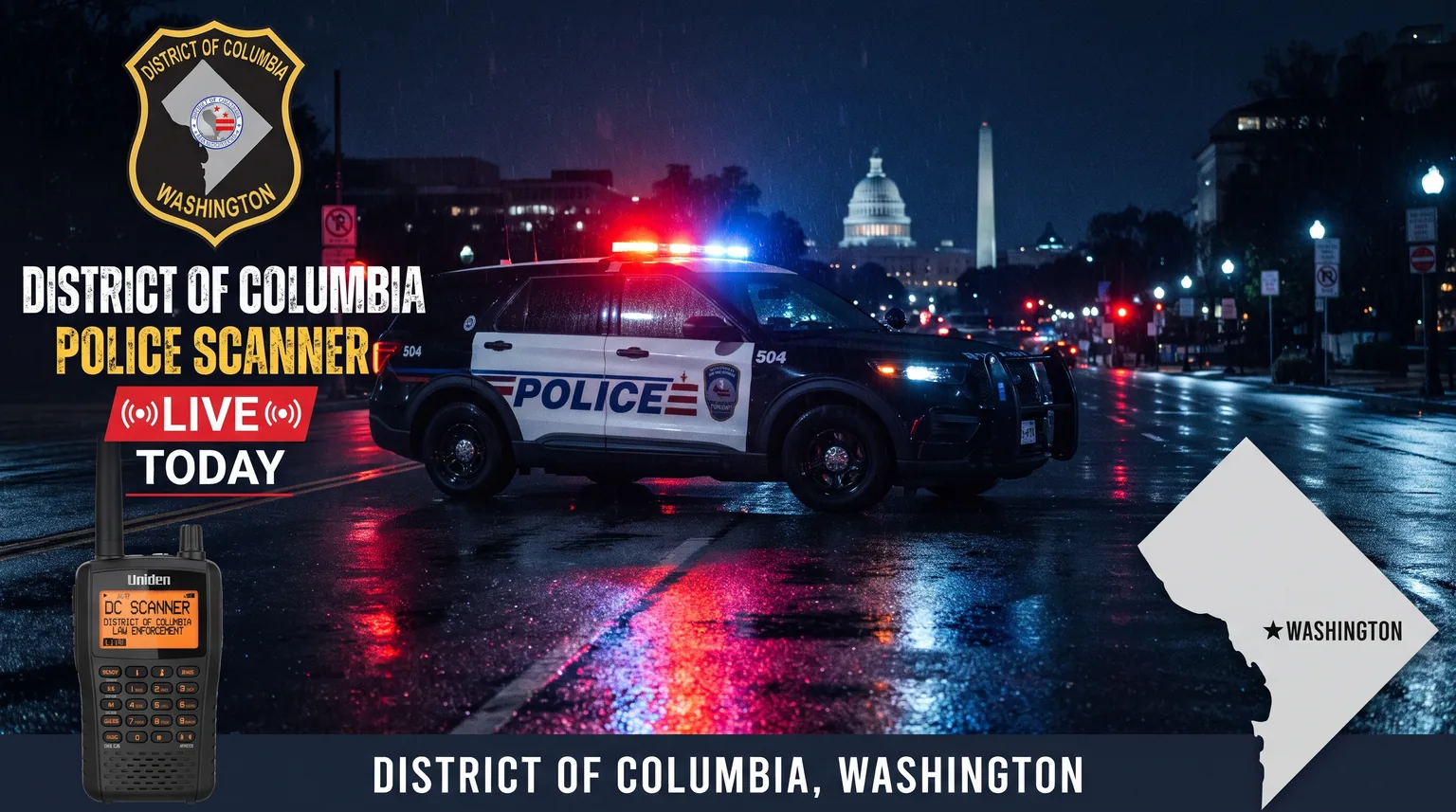
Scanner coverage in the District centers on DC Fire and EMS dispatch and operations, the Metropolitan Police citywide talkgroups, the U.S. Park Police on the National Mall, Metro Transit Police on the rail and bus system, the U.S. Capitol Police patch talkgroups, the DC Housing Authority Police, and the interoperability channels that link the District with Maryland and Virginia.
What you can hear in the District of Columbia
| Agency | Role | Jurisdiction | Radio system | Listening status (Nov 2026) |
|---|---|---|---|---|
| Metropolitan Police Department — district dispatch | City police patrol | Seven patrol districts, 1st–7th | DC P25 Phase II | Fully encrypted |
| Metropolitan Police Department — citywide talkgroups | Citywide calls | Districtwide | DC P25 Phase II, TG 1039 | Clear |
| Metropolitan Police Department — tactical/task force | Tactical and task force | Districtwide | DC P25 Phase II | Fully encrypted |
| DC Fire and EMS | Fire and EMS | Districtwide | DC P25 Phase II, TG 101/102 | Clear |
| U.S. Park Police | Federal park police | National Mall, monuments, parkways | VHF analog / P25 | Varies by channel |
| WMATA Metro Transit Police | Transit police | Metrorail and Metrobus | WMATA system | Partly encrypted |
| U.S. Capitol Police | Federal police | Capitol complex | DC P25 Phase II (patch) | Varies by channel |
| U.S. Secret Service Uniformed Division | Federal protection | White House and protected sites | Federal systems | Fully encrypted |
| DC Housing Authority Police | Housing police | District housing properties | DC P25 Phase II, TG 1227 | Clear |
Is District of Columbia police radio encrypted?
| Agency | Status | As of | What it covers |
|---|---|---|---|
| Metropolitan Police Department — district dispatch talkgroups | Fully encrypted | November 2026 | All seven district dispatch talkgroups encrypted since the District’s encryption policy took effect in November 2011; e.g. 1st District TG 11025 |
| Metropolitan Police Department — citywide talkgroups | Clear | November 2026 | MPD Citywide 1 (TG 1039) and other citywide/interop talkgroups remain in the clear |
| Metropolitan Police Department — tactical/task force talkgroups | Fully encrypted | November 2026 | E.g. DC Task Force SED (TG 1317), Force Investigation Team/OPR (TG 11115) |
| DC Fire and EMS — dispatch and operations | Clear | November 2026 | Fire Dispatch TG 101 and Main Operations TG 102 in the clear; some EMS-to-hospital talkgroups sometimes encrypted, sometimes not; a few FEMS talkgroups encrypted |
| DC Fire and EMS — VHF simulcast | Clear | November 2026 | Fire dispatch simulcast on 154.1900 MHz (PL 77.0), analog |
| U.S. Park Police | Varies by channel | November 2026 | Older reports conflict: 2017 reports say VHF analog in the clear; a 2018 report says the Park Police moved to encrypted P25. Status Not verified as settled |
| WMATA Metro Transit Police | Partly encrypted | November 2026 | Some MTPD talkgroups clear; MTPD dispatch talkgroups flagged encrypted in the current database listing |
| U.S. Capitol Police | Varies by channel | November 2026 | Status Not verified in this pass — do not present as clear or encrypted |
| U.S. Secret Service | Fully encrypted | November 2026 | Not listenable; no channel detail presented |
The Metropolitan Police Department encrypted its district dispatch talkgroups in November 2011, after police said scanner apps let criminals stay ahead of police movements. The policy was announced in late August 2011 and took effect over the following two weeks, and journalists and neighboring public-safety officials criticised the move — one senior public-safety official said it put interoperability back ten years for the region. DC Fire and EMS did not encrypt, and its dispatch and main operations talkgroups are still in the clear today. What is left of the Metropolitan Police on the air is the citywide talkgroups, mostly dispatchers calling for a detective unit or a tow truck, not routine patrol traffic. The Park Police picture is unresolved: 2017 reports describe VHF analog in the clear, while a 2018 report describes a move to encrypted P25, so this page lists the Park Police as varying by channel rather than as settled either way. Metro Transit Police are partly encrypted: some of their talkgroups are listed as clear, while their dispatch talkgroups are flagged as encrypted in the current database listing.
Radio systems and frequencies
The District runs one main trunked system, the District of Columbia Trunking System, a Project 25 Phase II system, Sysid 445, WACN BEE00. Its encryption settings were updated for two police talkgroups as recently as September 1, 2026. Fire dispatch is also simulcast on analog VHF, so even an old analog scanner hears it. The historic UHF frequencies once used by the Metropolitan Police, 453.4500 and 460.0250 MHz, are from a historic trunk system and are not current dispatch channels, so they are listed here as historic only and not as channels to program.
District of Columbia Trunking System — P25 Phase II
| Item | Value |
|---|---|
| System | District of Columbia Trunking System, Project 25 Phase II |
| System ID | Sysid 445, WACN BEE00 |
| System listing date | September 1, 2026 (encryption settings updated for 2 police talkgroups) |
| MPD 1st District dispatch | TG 11025 (2b11) — Encrypted |
| MPD Citywide 1 | TG 1039 (40f) — Clear |
| MPD DC Task Force SED | TG 1317 (525) — Encrypted |
| MPD FIT-OPR | TG 11115 (2b6b) — Encrypted |
| MPD USCP 1 (Capitol Police patch) | TG 1312 (520) |
| MPD DCTF1 (DC Task Force 1) | TG 1316 (524) |
| MPD MIRS | TG 1201 (4b1) |
| DCHA PD (Housing Authority Police) | TG 1227 (4cb) |
| Fire Dispatch | TG 101 (065) — Clear (“01 DISP”) |
| Fire Main Operations | TG 102 (066) — Clear (“02 MAIN”) |
| Interop | RIZ-01 UCC 1 (TG 166), RIZ-07 MAF1 (TG 621), RIZ-16 CW-1 (TG 1039) |
Only the 1st District dispatch talkgroup ID was verified in this pass. The other six districts each have their own dispatch talkgroup and every one of them is encrypted, but their IDs were not verified, so no IDs are invented for them here.
Conventional frequencies, District of Columbia
| Frequency (MHz) | Agency and use | Mode |
|---|---|---|
| 154.1900 (PL 77.0) | DC Fire/EMS dispatch simulcast | FM |
| 154.2350 | DC EMS coordination | FM |
| 154.2050 | DC fireground operations | FM |
| 453.4500 | Historic MPD UHF trunk system channel (not current) | FM |
| 460.0250 | Historic MPD control/voice channel (not current) | FM |
Recent radio changes
| Date | Change |
|---|---|
| November 2011 | MPD district dispatch talkgroups encrypted under the District’s encryption policy; DC Fire/EMS did not encrypt |
| January 1, 2026 | Jeffery W. Carroll becomes interim chief of the Metropolitan Police Department, succeeding Pamela A. Smith |
| September 1, 2026 | District trunking system listing updated; encryption settings updated for 2 police talkgroups |
| November 3, 2026 | Janeese Lewis George wins the mayoral election |
| January 2, 2027 | Janeese Lewis George takes office as mayor, succeeding Muriel Bowser |
Agencies
Metropolitan Police Department
The Metropolitan Police Department is the District’s police force, divided into seven patrol districts, 1st through 7th, each with its own dispatch talkgroup — and every one of them is encrypted. Interim Chief of Police Jeffery W. Carroll has led the department since January 1, 2026, succeeding Pamela A. Smith, who was chief from July 2023 to December 2025. The department is dispatched by the Office of Unified Communications, the District’s 911 center. The only Metropolitan Police traffic a scanner hears is on the citywide talkgroups, chiefly Citywide 1, TG 1039, where the traffic is mostly dispatchers calling for a detective unit or a tow truck.
DC Fire and EMS Department
The District of Columbia Fire and Emergency Medical Services Department provides fire and EMS for the District, plus mutual aid with surrounding Maryland and Virginia counties. Fire and EMS Chief John A. Donnelly Sr. leads the department. Its dispatch talkgroup, TG 101, and its main operations talkgroup, TG 102, are in the clear on the District’s P25 Phase II system, and dispatch is also simulcast on analog VHF at 154.1900 MHz, so fire is the reliable listen in the District. Some EMS-to-hospital talkgroups are sometimes encrypted and sometimes not, and a few FEMS talkgroups are encrypted, but dispatch and main operations are in the clear.
Office of Unified Communications
The Office of Unified Communications, known as OUC, is the District’s 911 center, dispatching the Metropolitan Police Department, DC Fire and EMS and other District agencies from one center.
United States Capitol Police
The United States Capitol Police patrol the Capitol complex, alongside the Metropolitan Police. Their status was not verified in this pass, so this page lists them as varying by channel and presents no encryption claim for them. The District system carries Capitol Police patch talkgroups, TG 1312 and TG 1314, but no status is claimed for those patches here.
United States Park Police
The United States Park Police patrol the National Mall, the monuments and the parkways — the most visible federal police presence in the city. Their current radio status is unresolved: 2017 reports describe them on VHF analog in the clear, while a 2018 report describes a move to encrypted P25 digital channels. This page therefore lists them as varying by channel and does not present either version as settled.
Metro Transit Police
The Metro Transit Police, the police force of the Washington Metropolitan Area Transit Authority, patrol Metrorail and Metrobus across the District, Maryland and Virginia. Their traffic is partly encrypted: some Metro Transit Police talkgroups are listed as clear on the WMATA system, while their dispatch talkgroups are flagged as encrypted in the current database listing. The WMATA system is a Motorola Type II SmartZone system carrying analog and P25 voice, and the system listing is dated March 11, 2026.
U.S. Secret Service Uniformed Division and other federal agencies
The U.S. Secret Service Uniformed Division protects the White House and other protected sites in the District, and its traffic is fully encrypted and not listenable. The DC Housing Authority Police, who patrol District housing properties, are listed as clear on the District system on TG 1227. The FBI, ATF, DEA and other federal agency police also operate in the District, mostly on encrypted federal systems.
Coverage across the District
The District of Columbia covers 68.3 square miles, with 61.1 square miles of land — the smallest and densest jurisdiction in the title sequence, at about 11,281 people per square mile, with 689,545 people in the 2020 Census. The National Mall and its monuments, the White House, the U.S. Capitol, the Supreme Court and Union Station sit in the center of the city, with the Potomac River to the west and the Anacostia River to the east. The Kennedy Center, Nationals Park and the Walter E. Washington Convention Center anchor the city’s cultural and event districts. The District sits at the junction of Maryland — Montgomery and Prince George’s counties — and Virginia — Arlington and Fairfax counties — and mutual aid with those counties is routine.
Local radio codes and unit identifiers
The District’s identifiers are its seven Metropolitan Police districts, its fire dispatch and operations talkgroups, and its interop channels. A listener hears district numbers for police, talkgroup names for fire, and the citywide channel for the Metropolitan Police traffic that is still in the clear.
Identifiers heard in the District of Columbia
| Identifier | Meaning |
|---|---|
| MPD 1D–7D | Metropolitan Police Department, 1st–7th patrol districts (all encrypted) |
| TG 1039 | MPD Citywide 1 — the clear Metropolitan Police channel |
| TG 101 | DC Fire Dispatch (“01 DISP”) |
| TG 102 | DC Fire Main Operations (“02 MAIN”) |
| TG 1227 | DC Housing Authority Police |
| TG 1312 / 1314 | Capitol Police Patch 1 / 2 |
| TG 1201 | MPD Metropolitan Interoperability Radio System (MIRS) |
| TG 166 / 621 | Interop channels RIZ-01 UCC 1 / RIZ-07 MAF1 |
Is it legal to listen to a police scanner in the District of Columbia?
Yes, listening to a police scanner is legal in the District of Columbia. No District law bans owning a scanner or listening to traffic broadcast in the clear. The boundary is encryption: under the federal Electronic Communications Privacy Act, 18 USC 2511, intercepting or decrypting an encrypted communication is a federal offense, while receiving a readily accessible radio transmission is lawful. In practice for the District, that means listen to the clear channels listed on this page — DC Fire and EMS, the Metropolitan Police citywide talkgroups, the Housing Authority Police — do not try to decrypt the encrypted ones, do not transmit on public-safety frequencies, and do not use a scanner to help commit a crime. This page is general information, not legal advice.
How to listen
To hear the District, a scanner must be able to follow a P25 Phase II trunked system, because the District’s main system is P25 Phase II, Sysid 445. Program that system and add Fire Dispatch TG 101, Fire Main Operations TG 102 and MPD Citywide 1, TG 1039. No scanner, at any price, can hear the encrypted Metropolitan Police district dispatch talkgroups — encryption is not a reception problem and a better antenna will not fix it. For the simplest listen of all, program 154.1900 MHz on any analog scanner: DC Fire dispatch is simulcast there in analog FM, so even an old scanner hears it. A scanner that handles simulcast well matters in the dense urban core, where the simulcast system can break up on cheaper receivers.
Troubleshooting
If you hear fire traffic but no police traffic in the District, your scanner is working — the Metropolitan Police district channels have been encrypted since November 2011, not out of range. That is the single most common question about this city, and the answer is the 2011 encryption, not your setup. If you hear only dispatchers calling for detective units and tow trucks, you are on Citywide 1, TG 1039 — that is the only Metropolitan Police traffic left in the clear, and it is not a fault. If fire traffic is also silent, check that the scanner is following the District’s P25 Phase II system and that the 154.1900 MHz analog simulcast comes through, which confirms the radio itself is receiving.
Nearby counties
Montgomery County, Maryland; Prince George’s County, Maryland; Arlington County, Virginia; and City of Alexandria, Virginia.
Another Delaware county covered on this site is Sussex County Delaware Police Scanner Live Today, with live audio, frequencies, talkgroups and the county’s encryption status.
Frequently asked questions
Is Washington DC police radio encrypted? The Metropolitan Police district dispatch talkgroups have been fully encrypted since November 2011. The citywide talkgroups, including Citywide 1 (TG 1039), are still in the clear.
Can I listen to DC police on a scanner? Only on the citywide talkgroups. Routine district patrol traffic is encrypted and cannot be heard on any scanner.
What frequency is DC Fire dispatch? Fire Dispatch is talkgroup 101 on the District’s P25 Phase II system, simulcast on analog VHF at 154.1900 MHz (PL 77.0).
Does the District of Columbia have a sheriff? No. DC is not a county — it is a federal district with no county government, no county seat and no sheriff.
Why did DC encrypt its police radios? The encryption policy took effect in November 2011, after police said scanner apps let criminals stay ahead of police movements. Journalists and neighboring public-safety officials criticised the move.
Who is the mayor of the District of Columbia? Muriel Bowser is mayor at research time. Janeese Lewis George won the mayoral election on November 3, 2026 and takes office on January 2, 2027.
Who is the chief of the Metropolitan Police Department? Jeffery W. Carroll, interim chief since January 1, 2026, succeeding Pamela A. Smith.
What scanner do I need for Washington DC? A scanner that can follow P25 Phase II trunking for the District system. Any analog scanner hears DC Fire dispatch on 154.1900 MHz.
Is the U.S. Park Police encrypted? Not settled. Older reports conflict: 2017 reports say VHF analog in the clear, while a 2018 report says the Park Police moved to encrypted P25. This page lists them as varying by channel.
Is Metro Transit Police encrypted? Partly. Some Metro Transit Police talkgroups are clear, while their dispatch talkgroups are flagged as encrypted in the current database listing.
Why is my scanner quiet on the Metropolitan Police channels? Because the district dispatch talkgroups are encrypted. Hearing fire but not police means the scanner is working and the police traffic is encrypted.
Official public safety resources
Metropolitan Police Department, (202) 727-9099 (non-emergency; also dial 311); DC Fire and Emergency Medical Services Department; Office of Unified Communications (OUC); United States Capitol Police; United States Park Police; Metro Transit Police; U.S. Secret Service Uniformed Division; DC Housing Authority Police; National Weather Service Baltimore/Washington.
If you have an emergency, call 911.
One Comment